Image Worlds / Collective Memory

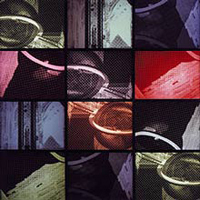
Maschinerie für Reuleaux
University of
Applied Sciences Cologne / Campus Gummersbach, 2007

Permanent kinetic slide projection installed in the entrance of the new building of the Capus. (Architect: Prof. Gerber, Dortmund). Andreas M. Kaufmann' s concept for a permanent artistic intervention has been awarded with the 1st prize in an international competition.
Art and architecture project of the federal state NRW, North Rhine-Westphalia, (Kunst + Bau Projekt des Landes NRW).
(videostream)
(more)
Permanent kinetic slide projection installed in the entrance of the new building of the Capus. (Architect: Prof. Gerber, Dortmund). Andreas M. Kaufmann' s concept for a permanent artistic intervention has been awarded with the 1st prize in an international competition.
Art and architecture project of the federal state NRW, North Rhine-Westphalia, (Kunst + Bau Projekt des Landes NRW).
(videostream)
(more)
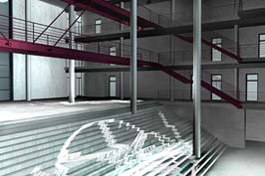
Freiheit ist die Optimale
Verteilung von Abhängigkeit, 2005 - 2010
Planned realisation in context of the Ruhr 2010, European Culture Capital.
Conception / modell 2005.
A VALUES ON DEMAND-Project for the exhibition Folkwang Artoll Kunst und Energie.
(more)
Conception / modell 2005.
A VALUES ON DEMAND-Project for the exhibition Folkwang Artoll Kunst und Energie.
(more)
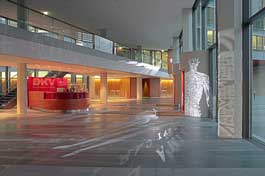
...neither body, nor soul..., 2006
DKV Deutsche Krankenversicherung
AG, Cologne, 2005 / 06
Permanent kinetic projection in the entrance hall of the new building of the DKV. (Architect: Jan Störmer, Hamburg). The images are moving through the hall, following a choreography, which is aligned to the sourrounding architecture. The graphical material of this digitally controlled slide installation stems from the book "De Humanii Corpore Fabrica", of which the first volume was published by the anatomist Andreas Vesalius in 1543.
(videostream)
(more)
Permanent kinetic projection in the entrance hall of the new building of the DKV. (Architect: Jan Störmer, Hamburg). The images are moving through the hall, following a choreography, which is aligned to the sourrounding architecture. The graphical material of this digitally controlled slide installation stems from the book "De Humanii Corpore Fabrica", of which the first volume was published by the anatomist Andreas Vesalius in 1543.
(videostream)
(more)
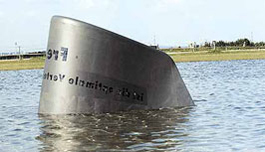
Stuffed Silence, 2005 / 2008
This work is aVALUES ON DEMAND-Project, conceived by Andreas M. Kaufmann,
dedicated to the Nigerian inventor of Afro Beat Fela Anikulapo Kuti
and realized in cooperation with the electronic musician Gabriel Ananda.
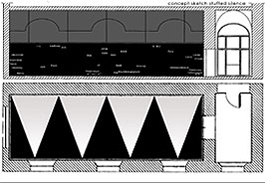
The choreographic conception of the video animation is made for a nonstandard extended surface: Four single projections should be bonded to one single screen. This screen should always be related to the architectonical site.
(videostream)
(more)
The choreographic conception of the video animation is made for a nonstandard extended surface: Four single projections should be bonded to one single screen. This screen should always be related to the architectonical site.
(videostream)
(more)
no agreement today, no
agreement tomorrow
Bergkamen 2004 - 2028
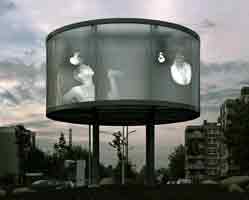
Site-specific architectural media sculpture at the Town Hall Gate roundabout. One slide is changed every year, thus the site specific sculpture contains a ritual and a process.
Technical data: 4 revolving projectors loaded in total with 24 slide
(videostream)
(more)
Site-specific architectural media sculpture at the Town Hall Gate roundabout. One slide is changed every year, thus the site specific sculpture contains a ritual and a process.
Technical data: 4 revolving projectors loaded in total with 24 slide
(videostream)
(more)
Last Supper Series, 2003
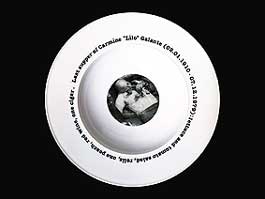
Concept and prototype
for a series of soup plates:The well of the plate is always showing
the photograph of a killed mafia boss; on the cavetto one can
read the name of the guy and what has been his last meal.
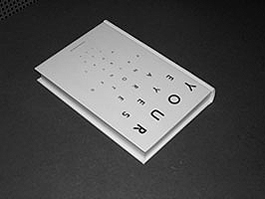
The Book Project, 2002 - 2005
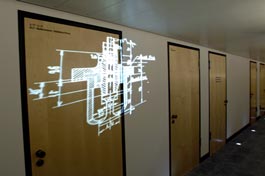
Andreas Kaufmann asked over 100 pretty different
people worldwide for a reaction towards a selection of public accessible
images, all collected by him. Before being published, the resulting book has manifested
itself in public two times: in the exhibition curated by Maria Anna Potocka "100%" at Bunkier
Sztuki Krakow (2002) and in the exhibition: "Claude Leveque, Andreas M. Kaufmann, Dan Graham:
Palais des arts - Present Distance" (Curator: Lydia Hempel / Site: "Palais im großen Garten",
Dresden (2005).
(more)
(more)
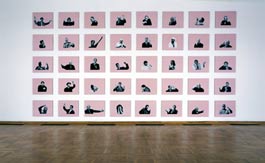
The Archive of Gestures, 2002
First presentation
at Galerie Gabriele Rivet, Cologne 2002
The open photographic project begun in 2002. Using the huge collection of publicly accessible images, which he has collected during the last 20 years, Kaufmann opend this image archive. All photos shown during exhibition are blurred so that the depicted person is nearly reduced to it's gesture.
Technical data: b/w photo prints.
(more)
The open photographic project begun in 2002. Using the huge collection of publicly accessible images, which he has collected during the last 20 years, Kaufmann opend this image archive. All photos shown during exhibition are blurred so that the depicted person is nearly reduced to it's gesture.
Technical data: b/w photo prints.
(more)
Ortlos II
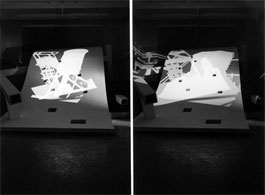
Ortlos
Gasometer Oberhausen,
1996
For the exhibition ICH PHOENIX - eine Kunstereignis, I re-worked drawings and photographs from various archives into pictogram-like signs until they were ultimately projectable slides.
Technical data: Rotating table, stage projector with circular cartridge and controls, 15 slides
(more)
For the exhibition ICH PHOENIX - eine Kunstereignis, I re-worked drawings and photographs from various archives into pictogram-like signs until they were ultimately projectable slides.
Technical data: Rotating table, stage projector with circular cartridge and controls, 15 slides
(more)

Umschau
Galerie G. Rivet,
Cologne 1996
More than any other medium, film has on the one one hand reflected, and on the other influenced the reality of life in our century. It has created images that have, in one way or another, permanently changed the behavior of human beings towards each other. These reflections are the background to the work.
Technical data: Three two-level rotating mechanisms, six carousel projectors, six carousels with 2 x 40 slides each (freeze frames from 61 films), shelving, 20 glass panes of varying sizes
(more)
More than any other medium, film has on the one one hand reflected, and on the other influenced the reality of life in our century. It has created images that have, in one way or another, permanently changed the behavior of human beings towards each other. These reflections are the background to the work.
Technical data: Three two-level rotating mechanisms, six carousel projectors, six carousels with 2 x 40 slides each (freeze frames from 61 films), shelving, 20 glass panes of varying sizes
(more)
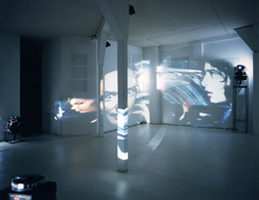
Flashback II
Gallery G. Rivet,
Cologne 1996
Kinetic projection of filmstills which is employing reflection.
Technical data: Ca. 12 panes of glass of different shapes and sizes, projector, timer, 80 slides
(more)
Kinetic projection of filmstills which is employing reflection.
Technical data: Ca. 12 panes of glass of different shapes and sizes, projector, timer, 80 slides
(more)
Machina Encyclopaedica
Wewerka Pavillon
Münster, 1995
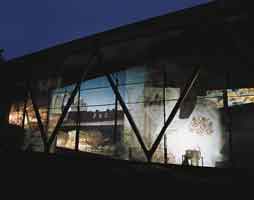
(...) the Pavillion is transformed into a dynamic and ever-changing public media sculpture space. Not only is the space public, but also the 1620 projected images, taken from the Brockhaus Encyclopedia are, like images on the internet, accessible to anyone who would like to see them.
Technical data: 10 two-level rotating mechanisms, 20 Kodak carousel projectors, 1620 slides, metal shelves
(more)
(...) the Pavillion is transformed into a dynamic and ever-changing public media sculpture space. Not only is the space public, but also the 1620 projected images, taken from the Brockhaus Encyclopedia are, like images on the internet, accessible to anyone who would like to see them.
Technical data: 10 two-level rotating mechanisms, 20 Kodak carousel projectors, 1620 slides, metal shelves
(more)
Sturz
Amsterdam, 1994
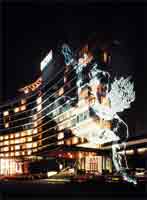
During the art fair "Art Hotel" the slide projection at the Hilton Hotel showed an engraving by Hendrik Goltzius ("Phaeton", 1588).
Technical data: Large format slide projector, one slide
(more)
During the art fair "Art Hotel" the slide projection at the Hilton Hotel showed an engraving by Hendrik Goltzius ("Phaeton", 1588).
Technical data: Large format slide projector, one slide
(more)
Who Ya Hunchin, 1994
Kunsthalle Recklinghausen,
1995
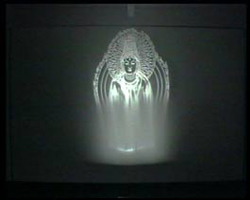
Above a basin filled with water, the personification of the Buddhist world of Taizo-Kai is projected on a wall. Beneath the basin of water a loudspeaker is placed, from which the Ella Fitzergald song Who Ya Hunchin can be continuously heard. The sound waves generated by the loudspeaker give rise to vibrations on the surface of the water, which in turn serves as a distorting mirror for the projection.
Technical data: Projector, slide, basin filled with water with built-in loudspeaker, CD player, amplifier
(more)
Above a basin filled with water, the personification of the Buddhist world of Taizo-Kai is projected on a wall. Beneath the basin of water a loudspeaker is placed, from which the Ella Fitzergald song Who Ya Hunchin can be continuously heard. The sound waves generated by the loudspeaker give rise to vibrations on the surface of the water, which in turn serves as a distorting mirror for the projection.
Technical data: Projector, slide, basin filled with water with built-in loudspeaker, CD player, amplifier
(more)
Kiss
Studio, 1994
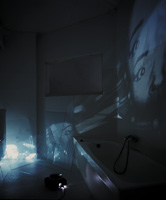
During James Stuart and Kim Novak's over one-minute long kiss in Alfred Hitchcock's film Vertigo the camera executes a 360% travelling shot around them. In this installation, the camera's circular movement is synchronised with the rotation of the video projectors.
Techical data: 1 video projector, 1 rotating mechanism
(videostream)
(more)
During James Stuart and Kim Novak's over one-minute long kiss in Alfred Hitchcock's film Vertigo the camera executes a 360% travelling shot around them. In this installation, the camera's circular movement is synchronised with the rotation of the video projectors.
Techical data: 1 video projector, 1 rotating mechanism
(videostream)
(more)
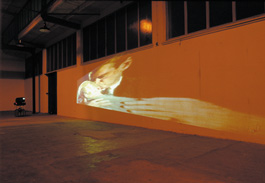
Zwang und Wiederholung, 1994
Wilhelm Lehmbruck Museum
Duisburg, 1995
This installation of light collages consists of 8 rotating slide projectors each of which contains 40 different newspaper photographs. The images are projected onto piles of old newspapers and the wall behind them. The projectors turn in a 360% arc.
Techical data: 8 Kodak carousel projectors, four rotating mechanisms, 8 carousels with 2 sets of 40 images each from newspapers from the past two years, old newspapers
(more)
This installation of light collages consists of 8 rotating slide projectors each of which contains 40 different newspaper photographs. The images are projected onto piles of old newspapers and the wall behind them. The projectors turn in a 360% arc.
Techical data: 8 Kodak carousel projectors, four rotating mechanisms, 8 carousels with 2 sets of 40 images each from newspapers from the past two years, old newspapers
(more)
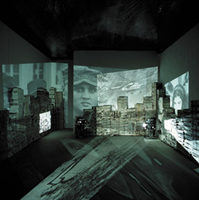
Die Erschaffung der Welt
Gyokozouin Tempel,
Urawa (Japan), 1993
Onto the Buddhist temple Gyokozouin and the trees in a small park before it was projected a tracing of Michelangelo’s ceiling fresco The Creation of the Sun, Moon and the Plantets (also: The Creation of the World).
Technical data: Stage projector, slide
(more)
Onto the Buddhist temple Gyokozouin and the trees in a small park before it was projected a tracing of Michelangelo’s ceiling fresco The Creation of the Sun, Moon and the Plantets (also: The Creation of the World).
Technical data: Stage projector, slide
(more)
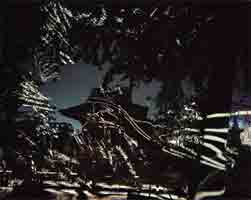
Allein mit viel zu viel, 1993
/ 1995
Willhelm Lehmbruck Museum,
1995
Each video projects the same sequence of images telling the same three stories, as seen from the perspective of the three protagonists in Kurosawa's film Rashomon. The three sequences would each be of different lengths if projected at normal speed, but here are projected at an extremely slow projection speed which is nonetheless synchronised in such a way that each sequence takes exactly the same amount of time.
Technical data: 3 videoprojectors, 3 video recorders, 3 video tapes
(videostream)
(more)
Each video projects the same sequence of images telling the same three stories, as seen from the perspective of the three protagonists in Kurosawa's film Rashomon. The three sequences would each be of different lengths if projected at normal speed, but here are projected at an extremely slow projection speed which is nonetheless synchronised in such a way that each sequence takes exactly the same amount of time.
Technical data: 3 videoprojectors, 3 video recorders, 3 video tapes
(videostream)
(more)
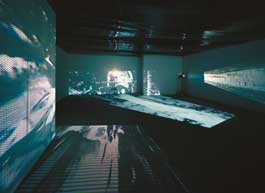
Große Kunstgeschichtsmaschinerie,
1992
Schloss Prestenek. Stein
am Kocher, 1993
The work was shown during the exhibition project "Bright Light". The installation was comprising an infinite number of light collages derived from reproductions of 280 paintings: all greatest hits in the history of art. Each carousel contains two identical sets of 40 images.
Technical data: 7 rotating mechanisms, 7 Kodak carousel projectors, 560 slides
(videostream)
(more)
The work was shown during the exhibition project "Bright Light". The installation was comprising an infinite number of light collages derived from reproductions of 280 paintings: all greatest hits in the history of art. Each carousel contains two identical sets of 40 images.
Technical data: 7 rotating mechanisms, 7 Kodak carousel projectors, 560 slides
(videostream)
(more)
Geschichtsbilder
Kloster/ Schloß
Corvey, Höxter, 1992
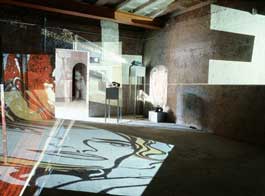
The anamorphotic projection was created for the exhibition project „In vier westfälischen Schlössern. Using illustrations of a manuscript of the epos "Dreizehn Linden", which was published in 1878, I created a pattern for two identical slides.
Technical data: Two stage projectors, two slides
(more)
The anamorphotic projection was created for the exhibition project „In vier westfälischen Schlössern. Using illustrations of a manuscript of the epos "Dreizehn Linden", which was published in 1878, I created a pattern for two identical slides.
Technical data: Two stage projectors, two slides
(more)
Auftritt der verwunderten Schönheit
Schirn-Kunsthalle
in Frankfurt / Main, 1992
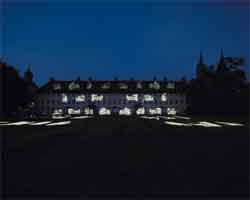
Anamorphotic light installation in the entrance of the Shirn. As a master for the projection served an illustration of Bellezza, which was exerpted from Cesare Ripas Iconologica (published 1603 in Rome).
Techical data: Stage projector, slide
(more)
Anamorphotic light installation in the entrance of the Shirn. As a master for the projection served an illustration of Bellezza, which was exerpted from Cesare Ripas Iconologica (published 1603 in Rome).
Techical data: Stage projector, slide
(more)
Kleine Kunstgeschichtsmaschine,
1991
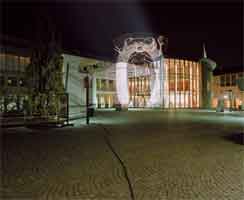
Since 1991 this
smoothly revolving slide-projection has flagged art institutions
and other public spaces all over the world. Despite the constant
speed of rotation, the viewer is enabled to experience the artwork
in various ways, depending on his own position in the space.
Techical Data: Rotating mechanism, Stage projector, slide.
(videostream)
(more)
Techical Data: Rotating mechanism, Stage projector, slide.
(videostream)
(more)
Trennung von Licht und
Finsternis
Museum Bochum,
1991
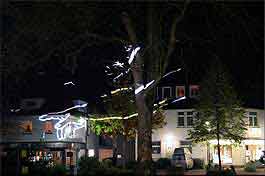
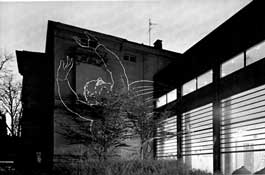
This intervention is part of the workgroup called the "Michelangelo-Project". An outlined drawing, taken from Michelangelo's Sistine ceiling fresco called "The separation of Light and Darkness" has been projected onto a wall of the museum 24 hours a day. The wall slice, which served as projection screen, starts outside and continues inside of the building as part of an exhibition space.
Technical data: 1 slide-projector, one slide (blank and black)
(more)
This intervention is part of the workgroup called the "Michelangelo-Project". An outlined drawing, taken from Michelangelo's Sistine ceiling fresco called "The separation of Light and Darkness" has been projected onto a wall of the museum 24 hours a day. The wall slice, which served as projection screen, starts outside and continues inside of the building as part of an exhibition space.
Technical data: 1 slide-projector, one slide (blank and black)
(more)
Der Mensch denkt in Bildern